CB-06 · Surface modelling · 21–24 Nov 2025
Rebuilding an organic image as editable geometry
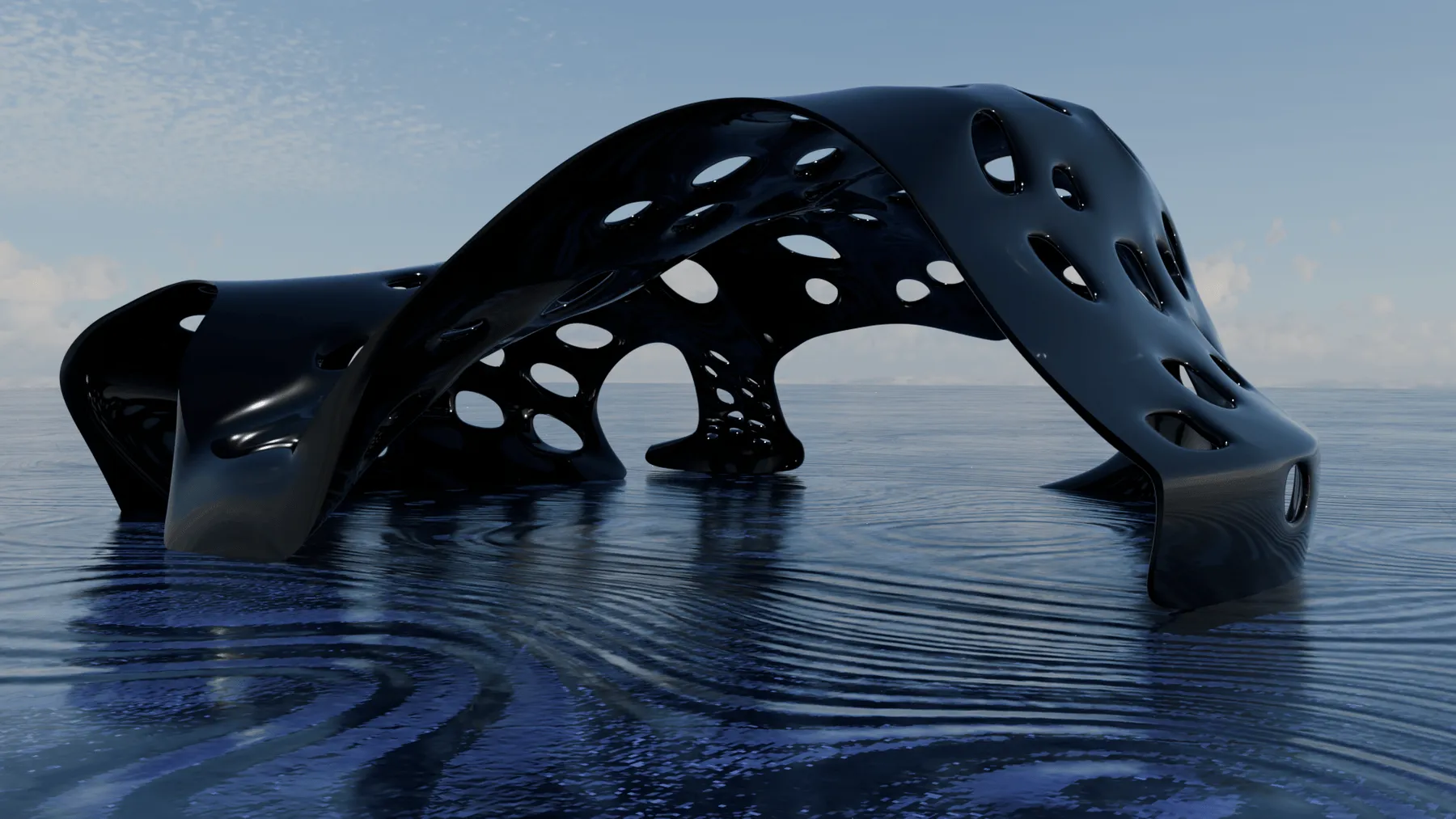
A perforated pavilion form developed through SubD modelling and visual review.
- Role
- SubD reconstruction, perforation modelling and presentation views
- Tools
- Rhino, Blender, 3DM / STL
- Period
- 21–24 Nov 2025
- Status
- Delivered and approved
I rebuilt a coral-like pavilion from a reference image, changed modelling methods when the first perforation approach failed, and delivered an editable model with printable-mesh exports.
The brief
The brief called for a smooth, hollow form with organic openings, an editable Rhino file and an STL for a scale model. The geometry had to capture the reference’s silhouette while accommodating thickness and fabrication considerations.
How it went
Clarify where precision mattered
I asked about bounding dimensions and hole tolerances. The client accepted approximate proportions and grouped hole sizes while emphasizing clean geometry and shell thickness.
Adapt the modelling method
I established the base SubD surface. When a curve-distribution and projection approach did not produce the desired perforations, I changed to a more direct process: subdividing, deleting faces and bridging the openings.
Use comparison views to choose the finish
I supplied versions with and without creased outer edges, plus clay views and Blender renders. The client selected the softer, uncreased version.
Respond to the print service constraint
After delivery, the client found that the model exceeded the service’s machine capacity. I supplied a scaled STL and an updated Rhino file.
The decision I would defend
The useful change was methodological: preserving the form while switching to a controllable way to create the openings, then letting the client choose the edge treatment through side-by-side views.
Outcome
The client approved the model and requested discussion of a further phase. Editable Rhino files, STL geometry and presentation images were delivered, followed by a size revision for the print service.
Delivered
- Uncreased STL model
- Editable Rhino model and working file
- Clay viewport images
- Blender renders
- Scaled STL and updated Rhino file
Scope and limits
Client approval and file delivery are documented; a completed physical print is not. Uniform 3.5 mm thickness everywhere, zero unsupported overhangs and all geometry checks were requested but are not independently verified here. Scaling can change thickness.
Posted as “3D Model Creation in Rhino from Reference Image” · Evidence of organic surface control · method adaptation · visual decision support